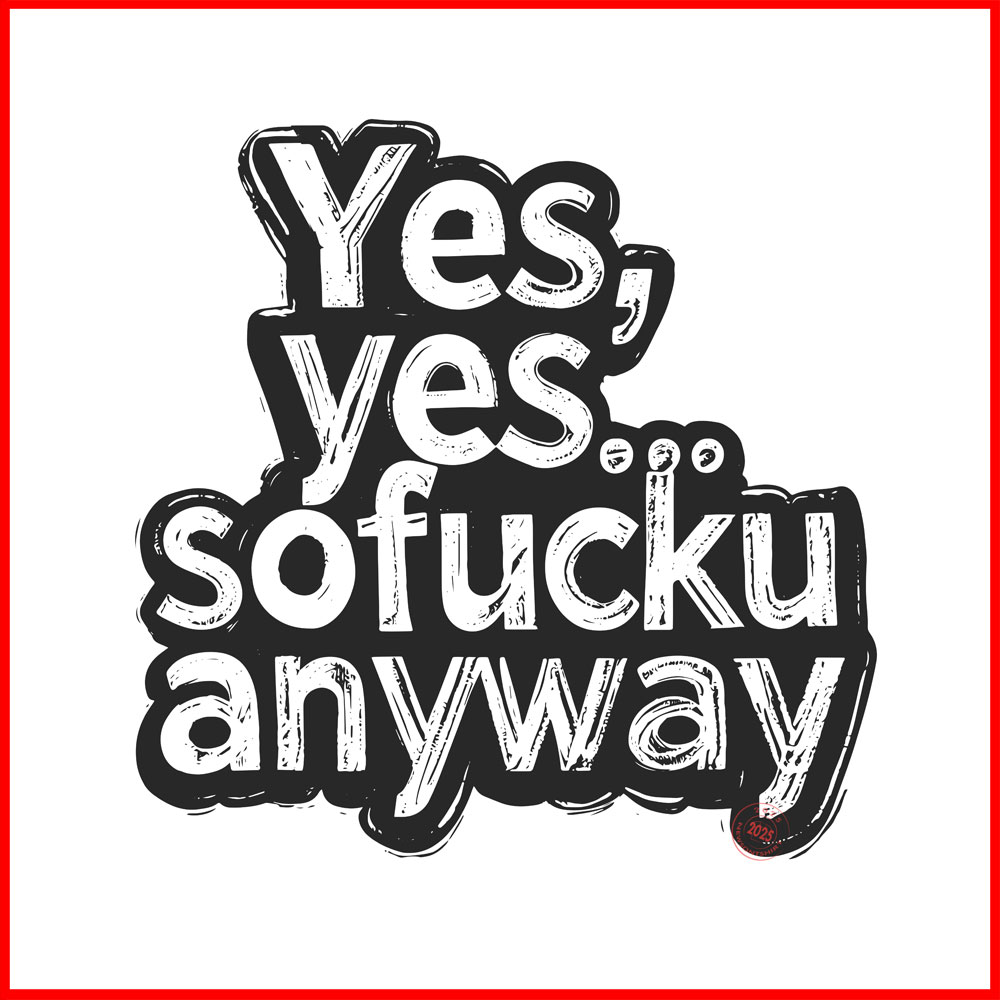
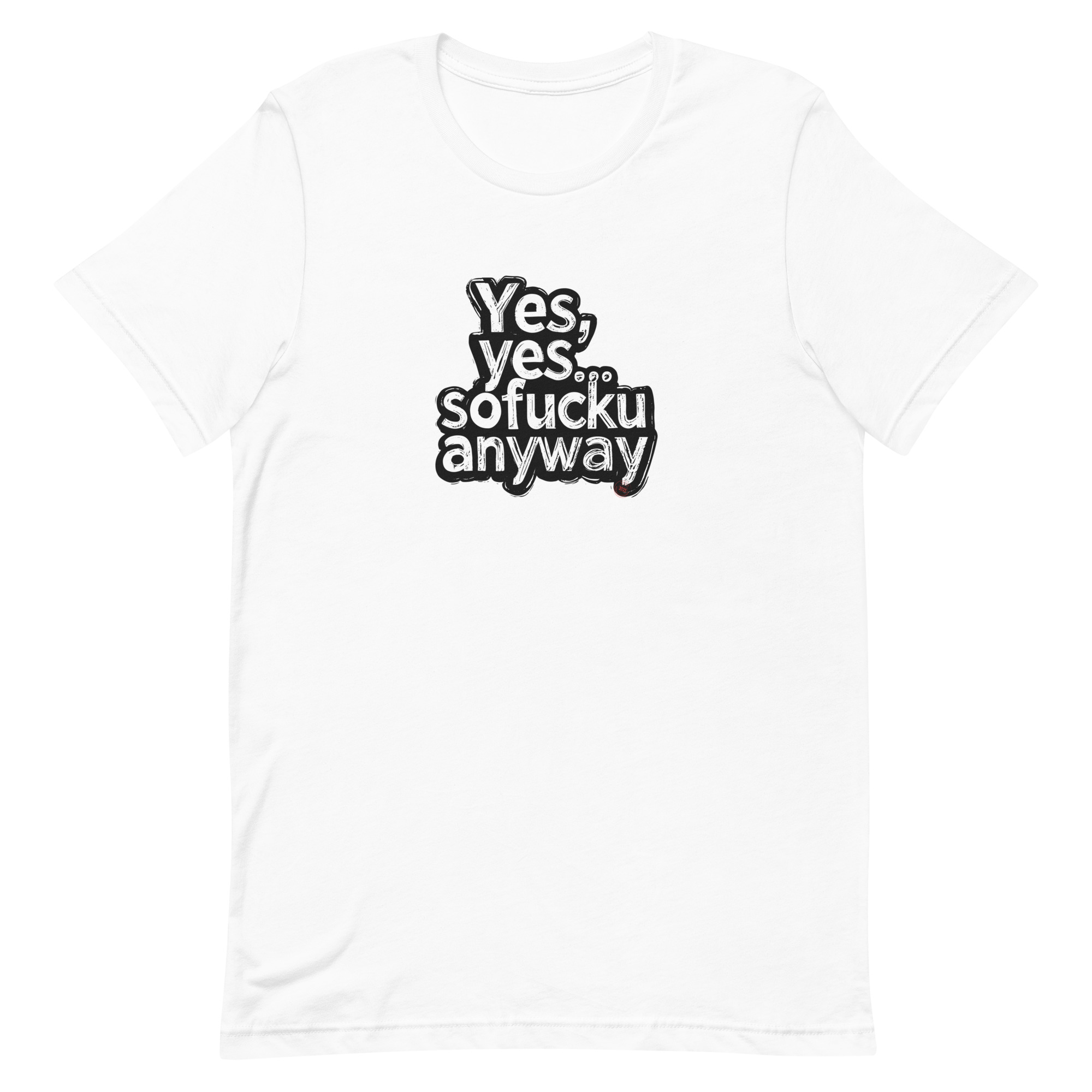
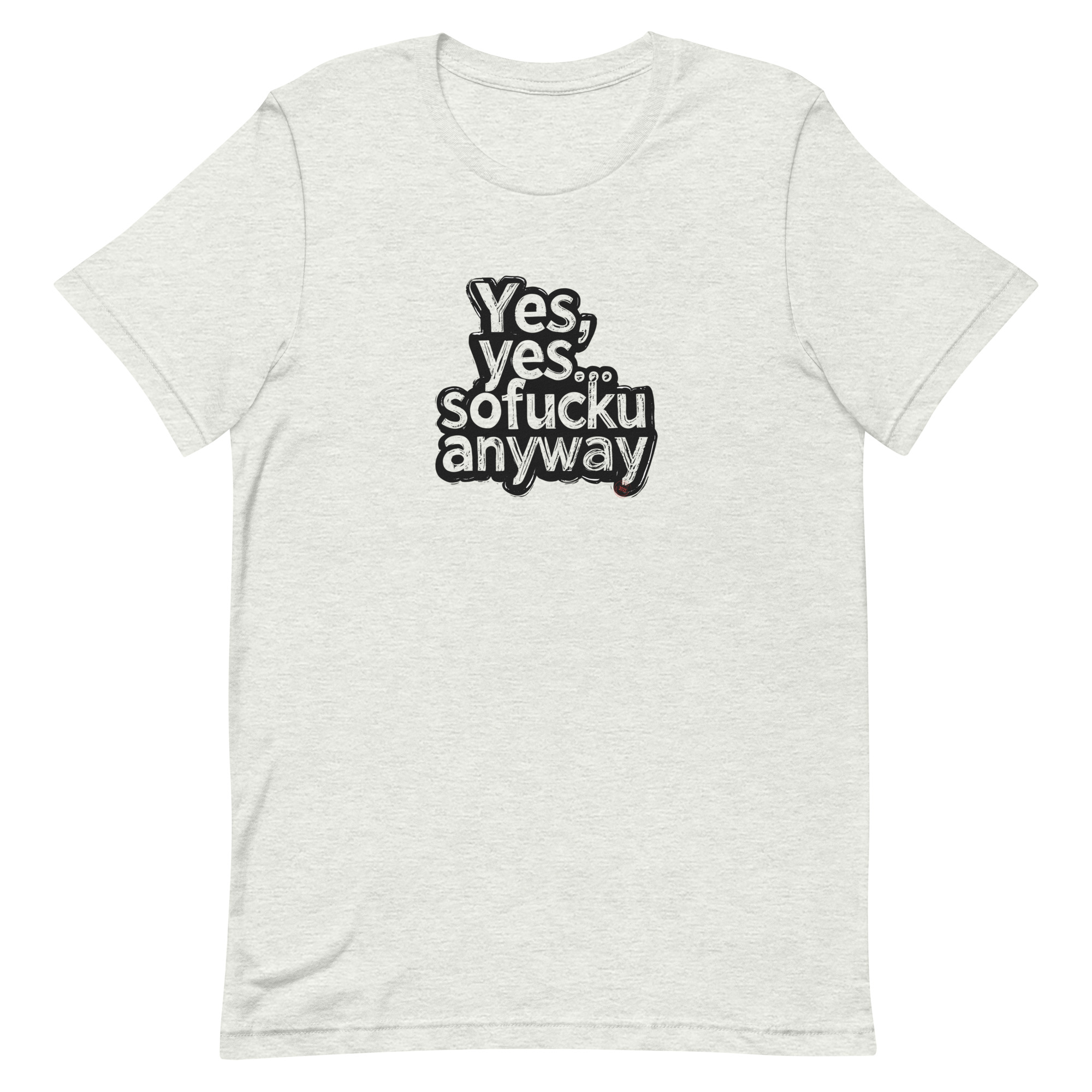
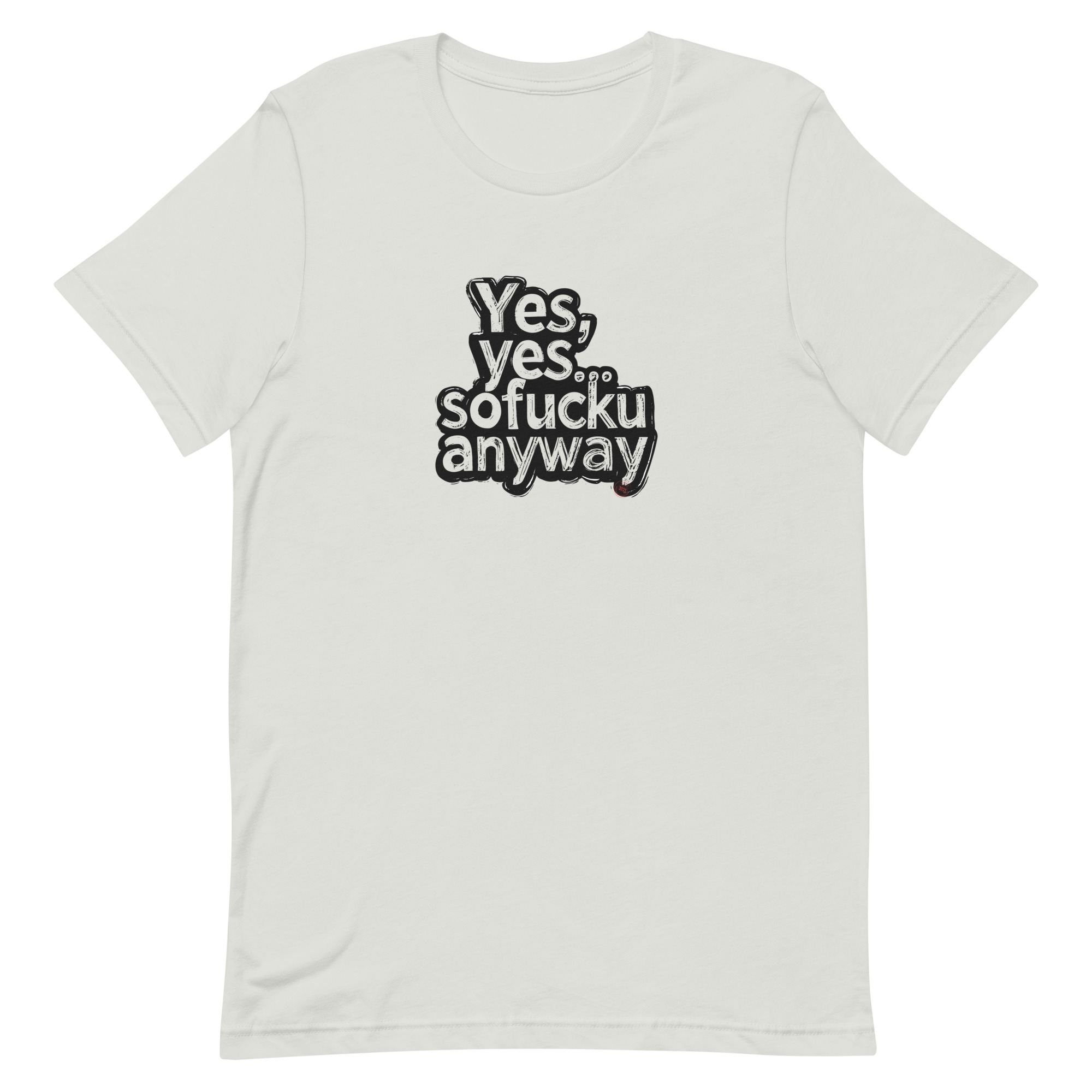
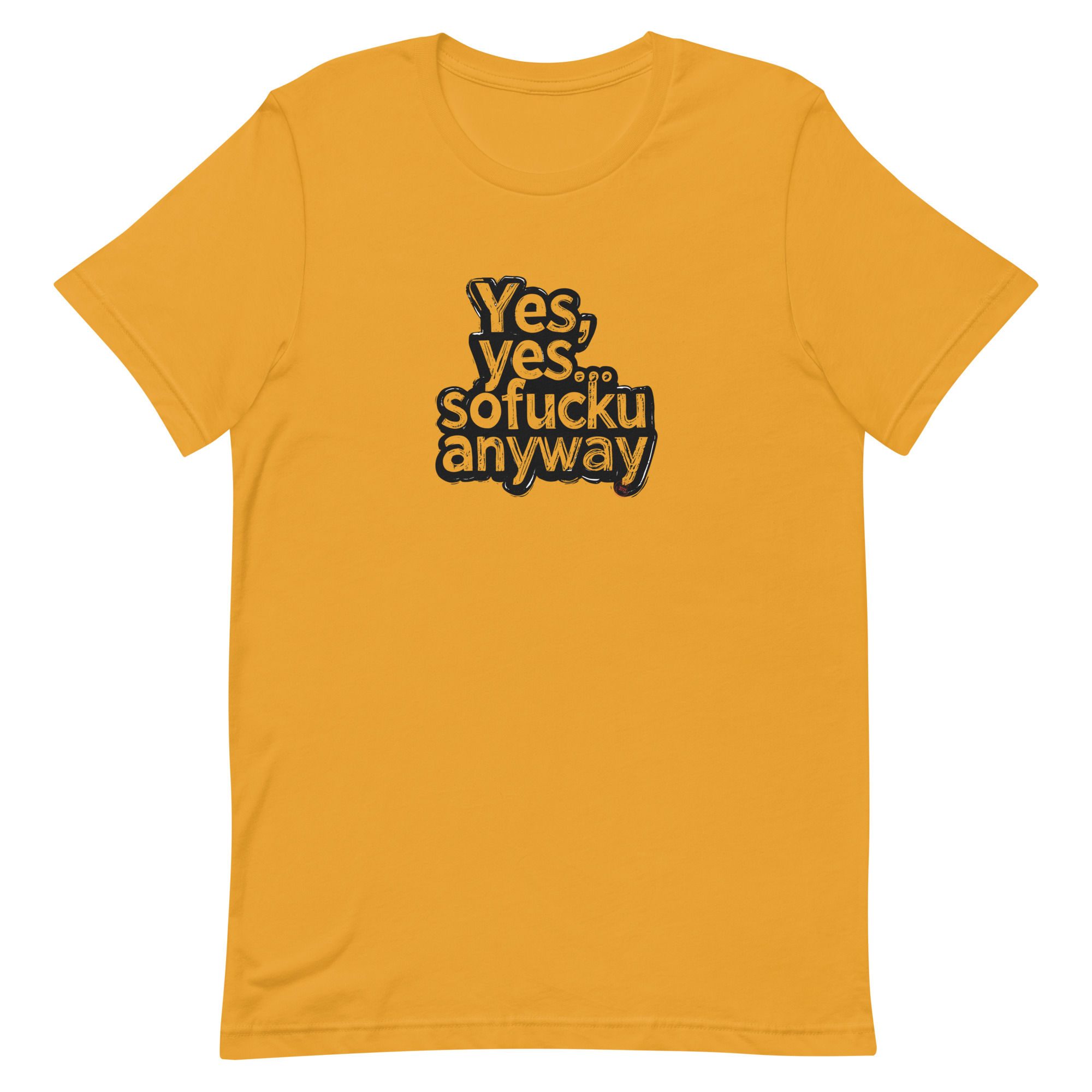
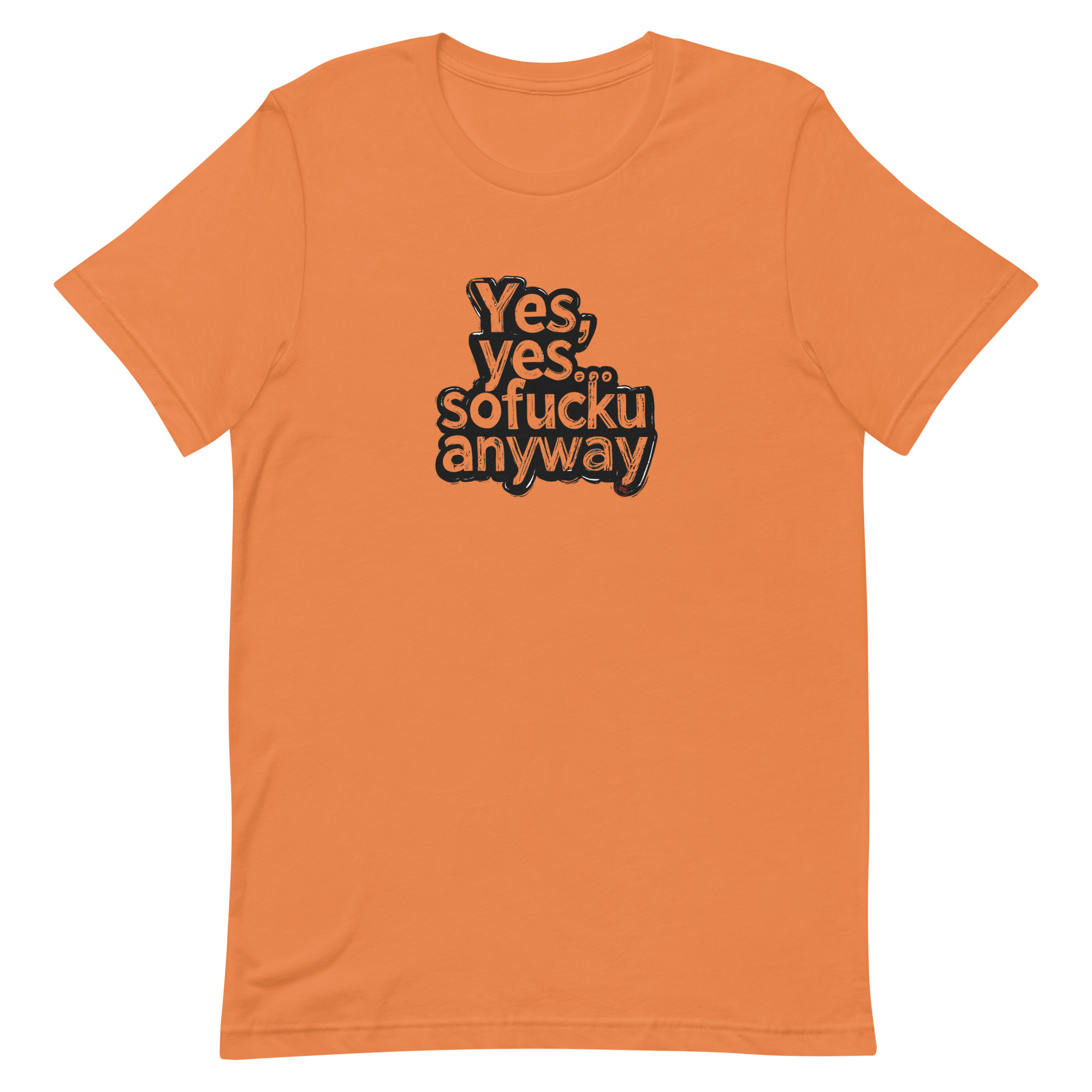
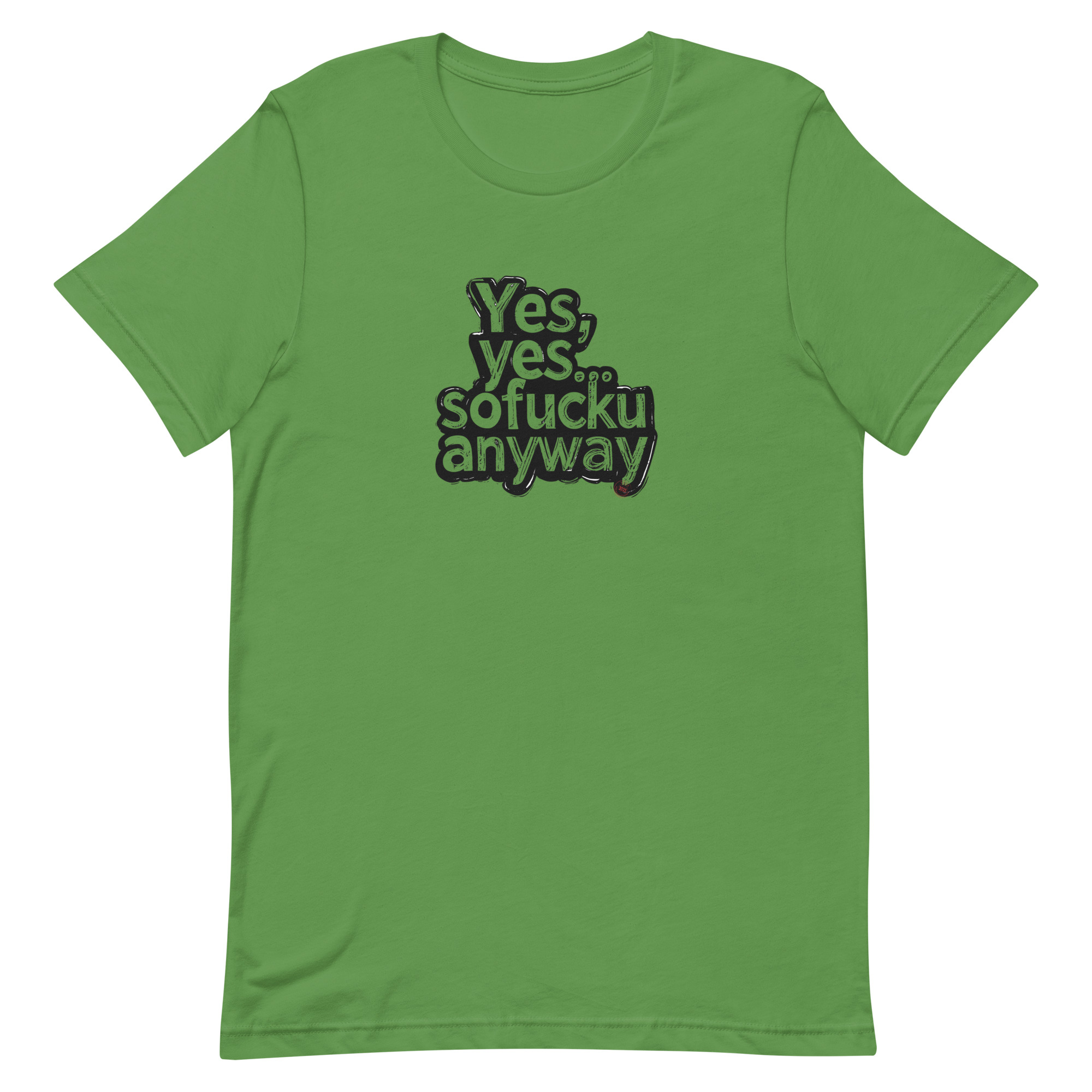
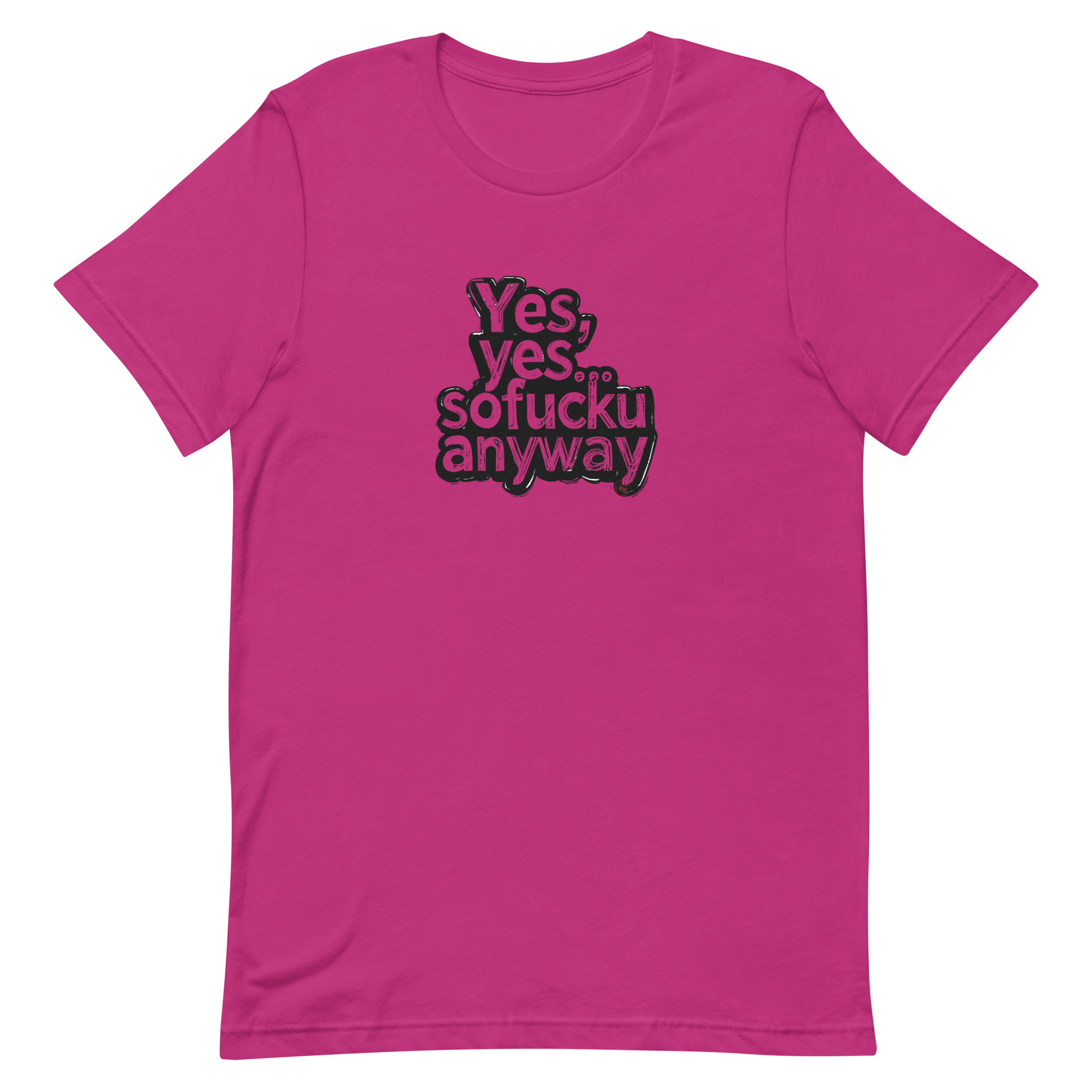
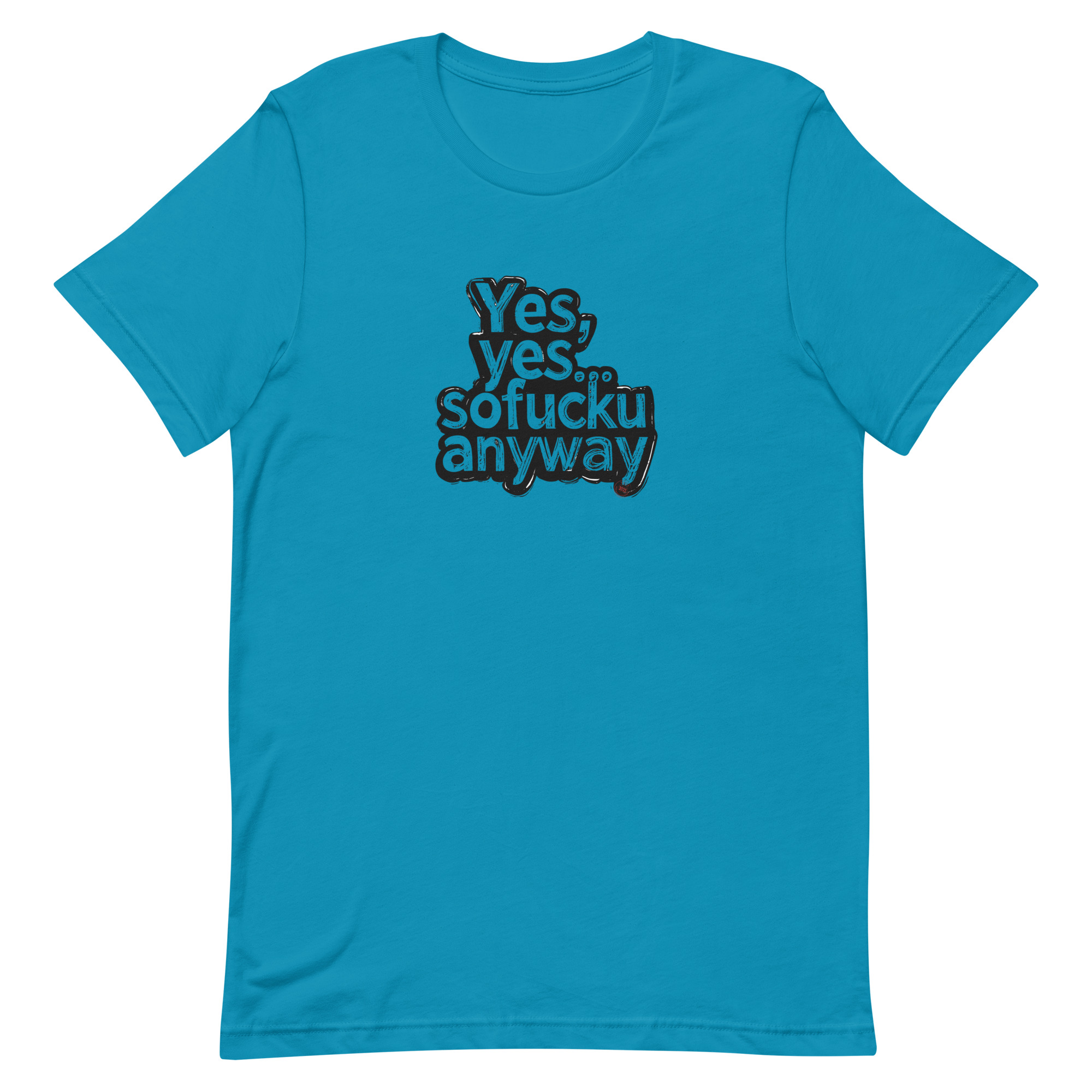
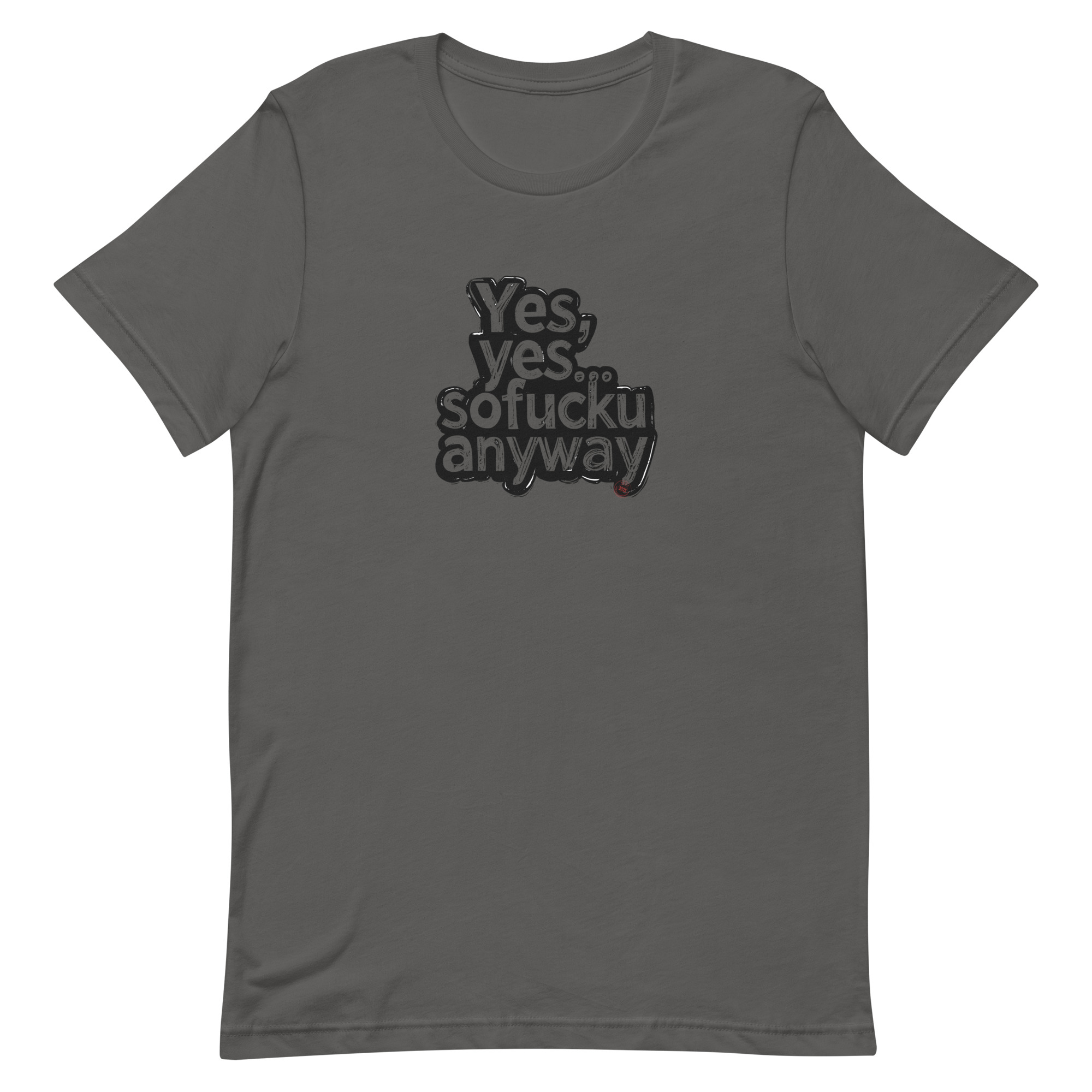
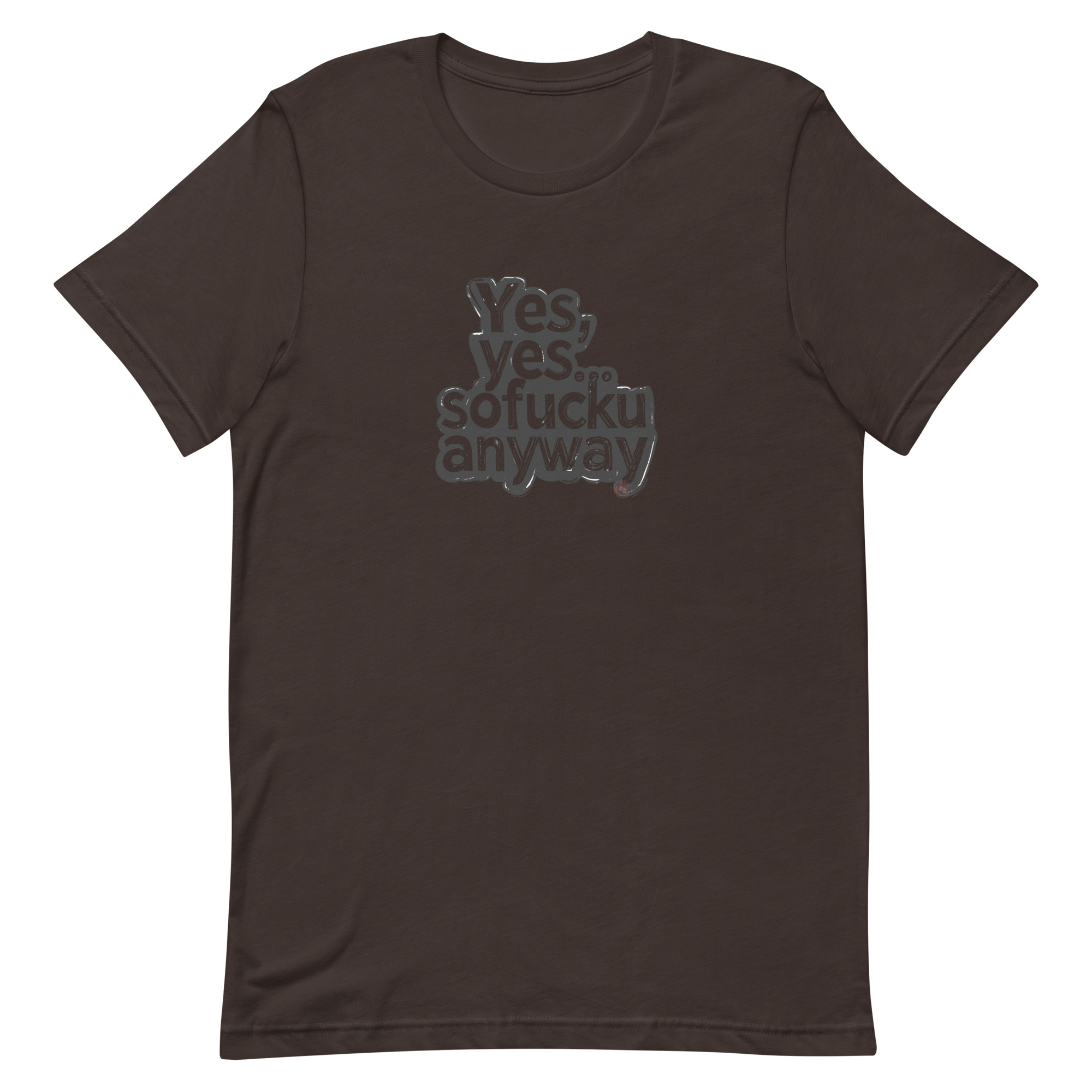


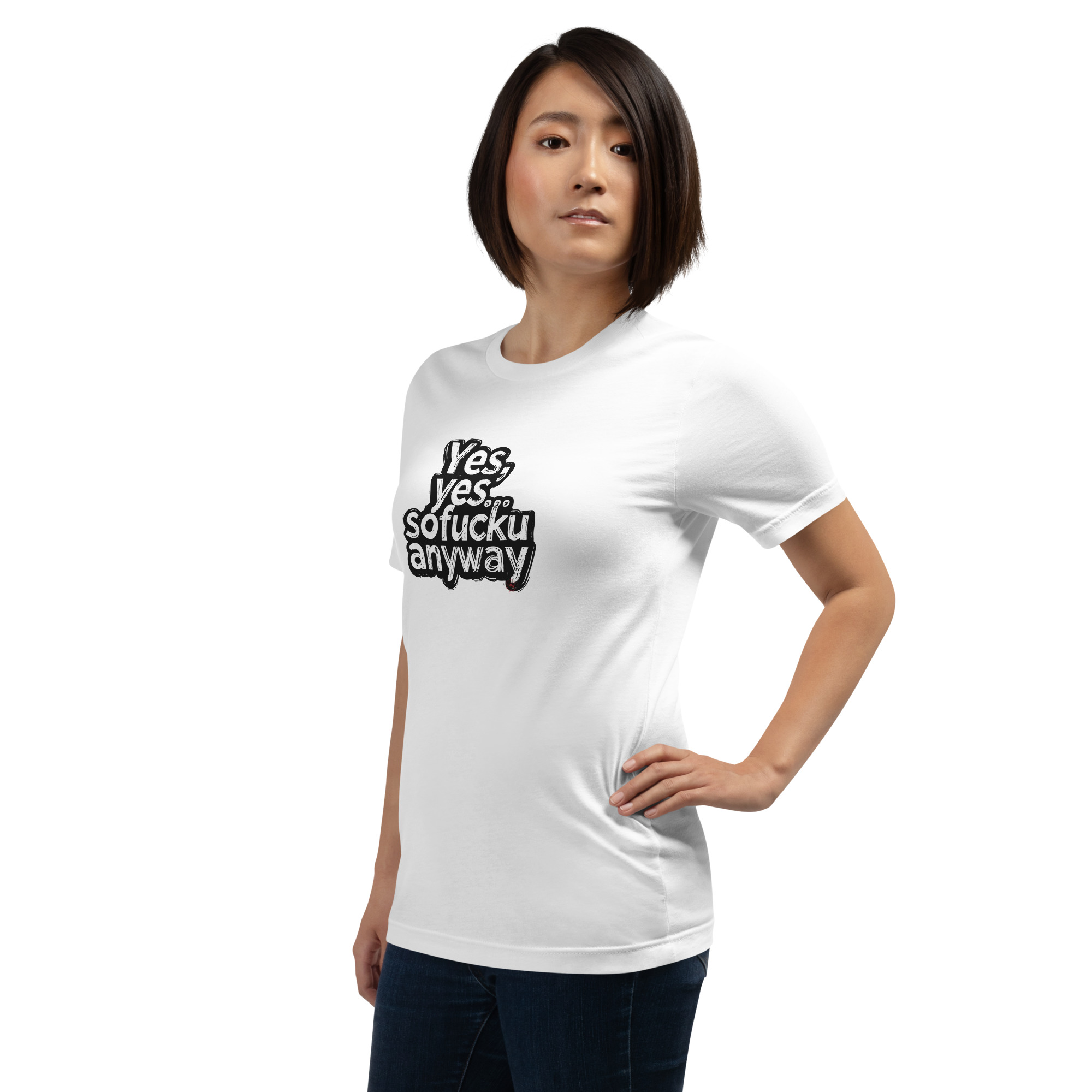
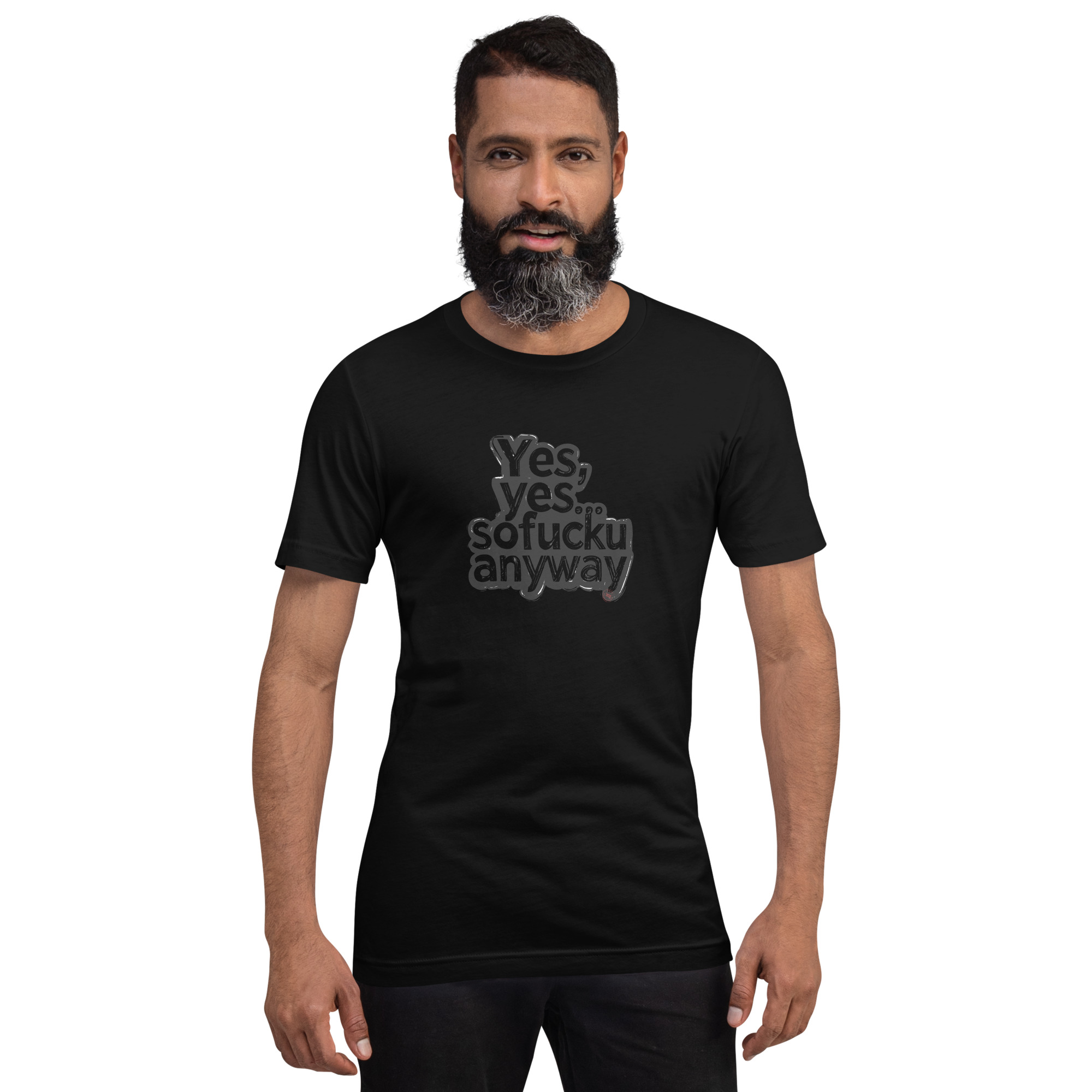

Yes, yes … So Fucku Anyway T-Shirt

£21.00

Size Guide

Description

“Yes, Yes, So Fucku Anyway” T-Shirt

“Yes, yes, so fucku anyway”is not just a rude sentence.

It is a mood.

It is that moment when your mouth says “yes”, but your mind has already left the conversation.

You smile. You nod. You agree. However, inside, something very different is happening.

Maybe you do not want to argue. Maybe you want to avoid drama. Or maybe you are just tired of explaining yourself.

This T-shirt turns that hidden inner dialogue into a bold, funny, and brutally honest statement.

When “Yes” Does Not Mean Yes

Sometimes, people say yes because they truly agree.

Other times, they say yes because saying no feels too hard.

That second kind of yes is the dangerous one.

It looks polite from the outside. However, inside, it can hide frustration, resentment, stress, or silent rebellion.

That is the spirit behind“Yes, yes, so fucku anyway.”

It captures the gap between what we say and what we really feel.

The False Yes

A false yes happens when you agree to something against your real feelings.

You may accept a task you do not want. You may say yes to an invitation that drains you. You may agree with someone just to end the conversation.

At first, this seems easier.

However, the cost often comes later.

You feel annoyed. You feel trapped. You may even blame the other person, even though you never said what you really meant.

For this reason, the false yes is not harmless.

It can slowly damage your energy, your relationships, and your self-respect.

Why We Say Yes When We Want to Say No

People say false yes for many reasons.

Sometimes the reason is fear. Sometimes it is habit. Other times, it comes from the desire to be liked.

In many cases, we learned to please others before we learned to protect ourselves.

As a result, saying no can feel rude, selfish, or even dangerous.

But a forced yes is not true kindness.

It is often self-betrayal dressed as politeness.

Fear of Conflict

One common reason for the false yes is fear of conflict.

Many people do not like confrontation. They would rather agree than risk tension, criticism, or disappointment.

So they say yes.

However, the conflict does not really disappear. It moves inside.

Instead of an honest conversation, you carry the frustration alone.

That hidden frustration can grow into anger, sarcasm, distance, or passive-aggressive behavior.

The Need to Please

Another reason is the need to appear helpful.

Many people want others to see them as kind, available, and easygoing.

Because of that, they say yes too quickly.

They accept extra work. They offer help when they are already exhausted. They give time they do not really have.

At first, this may create approval.

Over time, though, it creates pressure.

A yes that comes from people-pleasing rarely feels free.

Weak Boundaries

The false yes often appears when personal boundaries are unclear.

If you do not know your limits, other people may define them for you.

You may say yes because you feel guilty. You may say yes because you fear rejection. You may also say yes because you do not believe your needs matter enough.

However, boundaries are not walls.

They are honest lines.

They help people understand what is okay, what is not okay, and what you can truly offer.

Social Conditioning

Many of us learned to be agreeable from a young age.

We learned to be polite. We learned to avoid making trouble. We learned to put other people’s comfort before our truth.

In some situations, this can help social life run smoothly.

However, when agreement becomes automatic, authenticity disappears.

You stop asking, “Do I really want this?”

Instead, you ask, “What answer will make this easier?”

That is where the false yes begins.

The False Yes at Work

The workplace is one of the most common places for the false yes.

People say yes to unrealistic deadlines. They accept extra tasks. They stay late. They take on responsibilities that do not belong to them.

Often, they do this to look professional, committed, or cooperative.

However, constant forced agreement can lead to stress and burnout.

It can also reduce the quality of the work.

A person who says yes to everything eventually has no energy left for what truly matters.

The False Yes in Social Life

The false yes also appears in friendships, family dynamics, and everyday social life.

You may accept an invitation when you need rest. You may agree to help someone when your own life already feels full. You may say yes just to avoid disappointing someone.

Of course, kindness matters.

However, real kindness does not require you to abandon yourself.

A resentful yes does not create real connection.

It creates emotional debt.

The Passive-Aggressive Yes

Sometimes, the false yes becomes passive-aggressive.

Someone agrees on the surface, but their actions tell another story.

They delay the task. They do it badly. They forget. They make small mistakes. Or they act annoyed while pretending everything is fine.

This kind of yes creates confusion.

It also damages trust.

Instead of saying no clearly, the person says yes and then resists in hidden ways.

That is why honesty is usually cleaner than silent sabotage.

The “Yes” That Ends the Conversation

Sometimes, people say yes just to stop a conversation.

They do not want more questions. They do not want to explain. They do not want to justify their position.

So they give a quick yes and escape the moment.

However, this can create bigger problems later.

The other person believes there is real agreement. Meanwhile, the person who said yes feels trapped by a promise they never truly wanted to make.

A fast yes can become a slow problem.

The Cost of a False Yes

A false yes may feel convenient in the moment.

However, it often carries a hidden price.

You may lose time. You may lose energy. You may lose trust in yourself.

Most importantly, you may start feeling disconnected from your own truth.

When your words do not match your feelings, something inside you becomes tense.

That tension is a message.

It tells you that your real answer was probably different.

Stress and Resentment

Every false yes adds pressure.

One unwanted commitment may seem small. But many unwanted commitments can become heavy.

You may start feeling tired, irritated, or overwhelmed.

Then resentment appears.

You resent the people who asked. You resent the situation. Sometimes, you even resent yourself for agreeing.

However, resentment often points to an unspoken boundary.

It shows you where a clearer answer was needed.

Loss of Authenticity

The more you say false yes, the harder it becomes to know what you really want.

You begin to perform agreement.

You become the easy person. The available person. The person who never causes problems.

But inside, you may feel unseen.

That is because people are not meeting the real you.

They are meeting the version of you that keeps saying yes.

Damaged Relationships

False agreement can damage relationships.

At first, it may look peaceful. However, the peace is not real if one person is hiding resentment.

Healthy relationships need honesty.

They need space for no, doubt, disagreement, and limits.

When people cannot be honest, connection becomes shallow.

For this reason, a respectful no can be more loving than a dishonest yes.

Lost Opportunities

Saying yes to the wrong things can block the right things.

When your time is full of unwanted commitments, you have less energy for your real priorities.

You may delay personal projects. You may ignore your creativity. You may miss better opportunities.

A false yes can look generous.

However, it can quietly steal space from your own life.

How to Break the Habit

Breaking the habit of the false yes does not mean becoming cold or selfish.

It means becoming honest.

You do not need to explain everything. You do not need to defend every boundary. Also, you do not need to make everyone comfortable with your answer.

Start with one simple change.

Pause before you agree.

That pause can save you from many forced yeses.

Pause Before Answering

A pause gives you space.

Instead of saying yes automatically, take a breath.

You can say:

“I need to think about it.”

“Let me check and get back to you.”

“I cannot answer right now.”

These phrases are simple, but powerful.

They interrupt the old pattern.

They give your real answer time to appear.

Learn to Say No Clearly

A clear no does not need to be aggressive.

It can be calm, short, and respectful.

You can say:

“No, I can’t do that.”

“Thanks for asking, but I’m not available.”

“I understand, but I can’t take this on.”

You do not need a dramatic explanation.

In fact, long excuses can weaken your boundary.

A clean no is often enough.

Set Better Boundaries

Boundaries help you protect your energy.

They also make your yes more honest.

When you know your limits, you can choose with more clarity.

You can decide what fits your time, values, and capacity.

As a result, your yes becomes stronger.

It is no longer a reflex.

It becomes a choice.

Listen to Your Body

Your body often knows the truth before your mind explains it.

A false yes may come with tension, tightness, heaviness, or irritation.

You may feel your stomach drop. You may clench your jaw. You may feel tired before you even begin.

These signs matter.

They can show you that your answer is not aligned.

So, before saying yes, notice your body.

It may already be saying no.

Empathy Without Self-Betrayal

You can understand someone without agreeing to everything they ask.

This is an important distinction.

Empathy does not mean self-sacrifice.

You can care about another person’s problem and still protect your own limits.

For example, you can say:

“I understand this is important to you. However, I can’t help this time.”

That answer is kind and honest.

It respects both people.

The Power of an Honest No

An honest no can feel uncomfortable at first.

However, it often creates more respect over time.

People know where you stand. They know your yes means something. They also learn to trust your words.

A false yes creates confusion.

An honest no creates clarity.

That is why saying no can become an act of integrity.

Why This Phrase Works on a T-Shirt

“Yes, yes, so fucku anyway”works on a T-shirt because it says the quiet part out loud.

It is funny, rebellious, and painfully relatable.

Everyone has had that moment.

You smile politely. You agree on the surface. Meanwhile, inside, your real response is much less diplomatic.

This design captures that inner contradiction with humor.

It is not soft. It is not polished. But that is exactly why it works.

A T-Shirt for Silent Rebels

This T-shirt is for people who know the art of the mental eye-roll.

It is for the ones who have nodded through nonsense.

It is for the ones who have said yes while thinking something completely different.

It is also for people who are learning to stop betraying themselves.

The message is cheeky, but there is truth underneath.

Sometimes, the most honest thing is the thing we do not say out loud.

Wear Your Inner Monologue

The“Yes, yes, so fucku anyway” T-Shirtturns hidden frustration into wearable humor.

It is a conversation starter.

It is a wink to people who understand the feeling.

It is also a reminder that agreement is not always real.

Behind a polite face, there may be a whole storm of thoughts.

This shirt gives that storm a voice.

Perfect for Bold Streetwear

This T-shirt works well as casual streetwear.

It fits people who like sarcastic humor, rebellious phrases, and designs with attitude.

You can wear it at a party, on a casual day out, at a music event, or anywhere you want your clothes to say something sharper.

It is not for people who want to blend in.

It is for people who enjoy a little discomfort, a little humor, and a little truth.

Final Thought

A false yes may keep the peace for a moment.

However, it can cost you your honesty.

The phrase“Yes, yes, so fucku anyway”captures that strange human contradiction.

We agree. We smile. We perform politeness.

Meanwhile, our real thoughts are somewhere else entirely.

This T-shirt celebrates that hidden truth with humor and attitude.

Wear it loud.

Wear it with irony.

And maybe, next time, let your yes mean yes — and your no mean no.


Below are some links related toYes, yes, so fucku anyway T-Shirt

  1. American Psychological Association (APA) on Assertiveness:  https://www.apa.org/topics– Provides information on assertive communication, the opposite of the “false yes.”
  2. National Institutes of Health (NIH) on Stress:  https://www.nimh.nih.gov/health/topics
  3. – Explores the impact of stress, often a consequence of saying “yes” when you shouldn’t.
  4. Harvard Business Review on Workplace Dynamics:  https://hbr.org/ – Search for articles on topics like workplace pressure, saying no at work, and communication. (Specific article links change frequently).
  5. Psychology Today on Social Dynamics:  https://www.psychologytoday.com/us – Search for articles on topics like people-pleasing, social anxiety, and the fear of rejection.
  6. Brené Brown’s Website on Boundaries and Authenticity:  https://brenebrown.com/ – Offers insights into the importance of boundaries and living authentically.
  7. World Health Organization (WHO) on Mental Health at Work:  https://www.who.int/news-room/fact-sheets/detail/mental-health-at-work – Discusses factors affecting mental well-being in the workplace, including workload and stress.
  8. Journal of Personality and Social Psychology (APA PsycNet):  https://psycnet.apa.org/PsycARTICLES – You can search for studies on conformity, social pressure, and communication (access may require subscription).
  9. Journal of Social and Personal Relationships (SAGE Journals):  https://journals.sagepub.com/home/spr – Offers research on interpersonal relationships, including dynamics of agreement and disagreement (access may require subscription).
  10. Gallup Workplace Articles:  https://www.gallup.com/workplace/ – Search for articles on employee engagement, burnout, and workplace well-being.
  11. The Gottman Institute (for relationship dynamics):  https://www.gottman.com/ – Provides insights into healthy communication in relationships, including expressing needs and disagreements.
We hope you like our project!

Follow us on: “Instagram“, “TikTok”, “Pinterest“, “Facebook“, “X”

News On T-Shirt

Additional information

WeightN/A
Brand

News On T-Shirt

Info

This t-shirt is everything you've dreamed of and more. It feels soft and lightweight, with the right amount of stretch. It's comfortable and flattering for all.

• 100% combed and ring-spun cotton (Heather colors contain polyester)
• Fabric weight: 4.2 oz./yd.² (142 g/m²)
• Pre-shrunk fabric
• Side-seamed construction
• Shoulder-to-shoulder taping
• Blank product sourced from Nicaragua, Mexico, Honduras, or the US

This product is made especially for you as soon as you place an order, which is why it takes us a bit longer to deliver it to you. Making products on demand instead of in bulk helps reduce overproduction, so thank you for making thoughtful purchasing decisions!

• Traceability:
– Weaving—India, South Korea
– Dyeing—El Salvador, California
– Manufacturing—Nicaragua, Mexico, Honduras, or the US
• Contains 0% recycled polyester
• Contains 0% dangerous substances

Reviews

There are no reviews yet.

Be the first to review “Yes, yes … So Fucku Anyway T-Shirt”

Your email address will not be published.Required fields are marked*